
 Free text 078 6005 2906
 247 Helpline 0808 808 8141
 Please donate
 Shop Now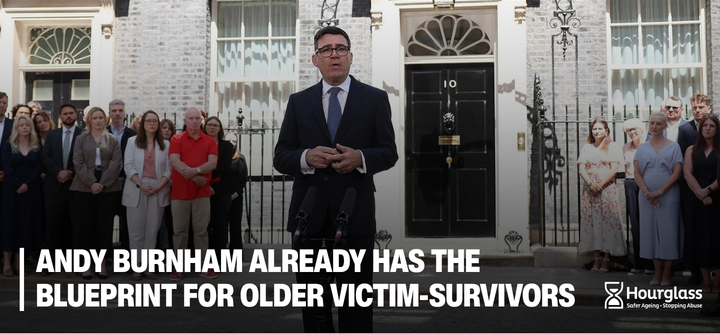
The Prime Minister arrives in office facing no shortage of challenges. But alongside the pressures of the economy, defence and public services is another issue that has remained hidden for far too long: the abuse of older people.
Every year, one in five older people across the UK experience abuse. It happens behind closed doors, most often in the victim's own home and, in the majority of cases, at the hands of someone they know and trust. Yet despite the scale of the problem, older victim-survivors continue to be overlooked in national policy, commissioning and public debate.
The encouraging news is that he does not have to begin with a blank sheet of paper. The Prime Minister has long championed the principle that the best ideas should not remain confined to one place. As he takes up the reins this week, there is an opportunity to put that principle into practice by building on a model that has already shown what is possible.
During Andy Burnham's mayoralty, Greater Manchester invested in specialist domestic abuse support for older people, recognising something that too often goes unacknowledged: older victim-survivors experience abuse differently.
Abuse in later life frequently takes place within long-established family relationships. It may involve coercive control by an adult child, decades of domestic abuse by a partner, economic exploitation, or abuse complicated by caring responsibilities, declining health or cognitive impairment. These experiences can make seeking help profoundly difficult.
Recognising these challenges, Greater Manchester invested in a specialist Independent Domestic Violence Advocate (IDVA) service delivered by Hourglass. Working alongside mainstream domestic abuse services, we provide dedicated support from professionals who understand the realities of abuse in later life and the additional barriers older people can face. It is a practical example of how specialist expertise can improve outcomes for older victim-survivors.
It is precisely this approach that should now inform national policy. Too often, the support available to older victim-survivors depends on where they happen to live. While some areas have invested in specialist provision, many have not. Access to appropriate support should never be determined by geography.
As Prime Minister, Andy Burnham now has the opportunity to build on that experience by taking three important steps.
-
First, he should ensure that older victim-survivors are explicitly recognised across domestic abuse, violence against women and girls, safeguarding and victims' policy by developing a national strategy on violence against older people.
-
Second, he should work with commissioners to expand specialist provision across England and Wales, building on successful models such as Greater Manchester. Every older person experiencing abuse should have access to professionals who understand the complexities of abuse in later life.
-
Finally, he should act to improve the evidence base. Better age-disaggregated data, stronger professional training and greater awareness across policing, health, housing and adult social care would help ensure abuse is recognised earlier and victims receive the support they deserve.
For too long, older victim-survivors have been left at the margins of government thinking. They are not a niche group, nor an afterthought. They are victims of domestic abuse, sexual violence, economic abuse and coercive control whose experiences deserve the same visibility, urgency and investment as those of any other victim.
Greater Manchester has already demonstrated what can be achieved when older victim-survivors receive specialist support designed around their needs. The Prime Minister now has the opportunity to build on that proven model so that, wherever an older person lives, they can access the understanding, protection and specialist support they deserve.


